

Pull out cabinet organizer kitchen upgrades are the single highest-impact change you can make to a cluttered lower cabinet, but the gulf between a $50 wire kit and a $400 soft-close system is enormous. This guide filters the 2026 market for a high-value, durable solution and teaches you exactly what generic budget kits hide so you can install it once and never think about it again.
As an Amazon Associate, I earn from qualifying purchases.
⚡ Quick Answer
A reliable pull out cabinet organizer kitchen retrofit in 2026 costs $150, $250 for a mid-range unit with full-extension ball-bearing slides. Avoid sub-$50 kits with roller slides that bind and tilt. The key to a no-regret purchase is verifying weight capacity, slide type, soft-close dampers, and installation method before you buy.
Key Takeaways
- In 2026, budget pull-out kits under $50 use simple roller slides and plain finishes, missing soft-close dampers, full-extension ball-bearing slides, and brushed-metal finishes that define a permanent upgrade.
- Mis-measured cuts causing slides to bind or tilt are the most frequent installation complaint. A 1/4 inch error in a slim pantry rack can make the entire unit wobbly.
- Look for kits with full-extension ball-bearing slides, soft-close dampers, and a weight capacity that matches what you store. Nano-adhesive mounting is a smart workaround if you want to avoid drilling into cabinet walls.
- The sweet spot for a durable DIY project is $150, $250, where you get most premium features without paying for unnecessary extras.
- The Real Cost of a Clean Pantry: What $50 vs. $400 Gets You in 2026
- The #1 Installation Complaint is “Did I Just Break This?”
- 2026 Trends Your Budget Kit Is Missing
- Your “No-Regret” Shopping Checklist (Slim vs. Standard vs. Deep)
- Conclusion
- Frequently Asked Questions
The Real Cost of a Clean Pantry: What $50 vs. $400 Gets You in 2026
In 2026 pull‑out cabinet organizers typically range from about $50 for a basic wire or MDF slide‑out kit to $400‑$500 for premium full‑extension ball‑bearing units with soft‑close, with most mid‑range options falling in the $150‑$250 window (sources: Wurth Lac, Home Depot). That price spread is not just about brand markup. It reflects fundamental differences in materials, hardware, and longevity.
A $50 kit typically uses thin MDF panels, basic roller slides, and a painted or laminate finish. It works for a few months but tends to stick, squeak, and sag under the weight of canned goods or heavy pots. A $150‑$250 unit uses powder‑coated steel or thick wood panels, full-extension ball-bearing slides, and at minimum a dampened closing mechanism. The $400+ range adds soft-close dampers, brushed-metal finishes, and sometimes integrated LED lighting.
For most DIY homeowners, the $150‑$250 band is the value sweet spot. You get the hardware quality that prevents the most common complaints without paying for professional installation or brand prestige.
The #1 Installation Complaint is “Did I Just Break This?”
The most frequent complaints about installing sliding cabinet shelf systems are mis‑measured cuts that cause the slides to bind or tilt, noisy or squeaky operation, insufficient weight capacity, hardware that loosens or breaks over time, and the difficulty of aligning tracks without professional tools (source: Wurth Lac). The binding and tilting issue is the one that stops most DIY projects cold.
Here is the survival strategy. Before you open any box, measure the cabinet opening width, depth, and height in three places. Cabinet openings are rarely perfectly square. If your cut is only 1/8 inch too wide, the slides bind when you try to close them. If it is 1/8 inch too narrow, the shelf rattles.
Many budget kits now include nano‑adhesive tape as an alternative to screws. This is a genuine innovation for renters or anyone nervous about drilling. The adhesive holds surprisingly well on clean, smooth cabinet interiors. However, it only works if you follow the curing instructions: apply the tape, press firmly for 30 seconds, and wait 24 hours before loading the shelf.
If you are installing a pull out drawer cabinet system in a base cabinet with a drawer front, measure the existing face frame overlap carefully. A misaligned face plate is the second most common complaint and makes the whole upgrade look amateur.
2026 Trends Your Budget Kit Is Missing
Budget pull out cabinet hardware often misses current trends such as soft‑close dampers, full‑extension ball‑bearing slides, brushed‑metal or satin finishes, integrated LED lighting, and eco‑friendly or recycled material construction, leaving cheaper kits with simple roller slides, plain finishes and no extra accessories (source: RTA Cabinet Store).
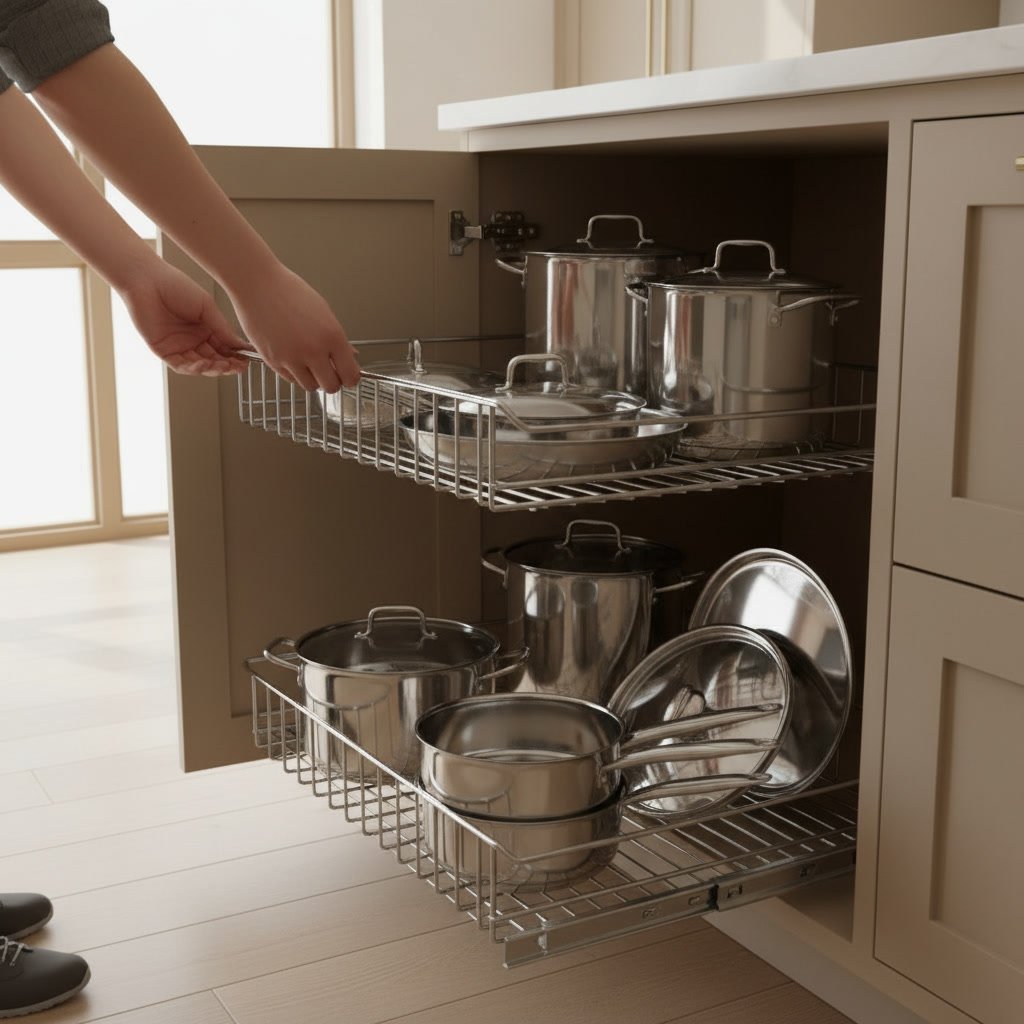
Soft-close is not a luxury add-on at this point. It is a baseline feature that prevents the shelf from slamming shut every time you push it. Full-extension slides let you access everything in the back of a deep cabinet without crawling inside. Ball-bearing slides support heavier loads and last longer than roller slides. If a kit does not explicitly list these three features, it is a temporary fix, not a permanent upgrade.
The finish matters more than you might think. Brushed or satin metal finishes resist fingerprints and smudges far better than chrome. For the kitchen cabinet pull out shelf you use every day, this is a noticeable quality of life improvement. Matte black hardware has been the dominant trend for years, but 2026 designers are shifting toward metallics like brushed nickel, champagne bronze, and satin brass (source: RTA Cabinet Store).
Your “No-Regret” Shopping Checklist (Slim vs. Standard vs. Deep)
Before you click “Add to Cart,” run through this checklist. It takes five minutes and saves you the pain of returning a poorly fitting unit.
1. Weight Capacity vs. What You Store
A pull out pantry slim unit for spices and cans does not need the same capacity as a deep unit for cast iron cookware. Most slim units handle 30-50 pounds. Standard units go up to 100 pounds. Overloading a kit with roller slides is what makes them sag and eventually break.
2. Full-Extension vs. 3/4 Extension
Full-extension slides let the shelf pull out completely so you can see and reach every item. 3/4 extension leaves 3-4 inches hidden at the back. For lower cabinets where you store pots, pans, or pantry items, full-extension is the only option that makes the upgrade worthwhile.
3. Slide Type: Ball-Bearing vs. Roller
Ball-bearing slides support more weight and operate more smoothly than roller slides. They cost more but last years longer. If the product page does not say “ball bearing,” it likely uses rollers. Move on.
4. Soft-Close Inclusion
As noted above, soft-close dampers are standard on any kit priced above $150. If you find a kit without them, factor in the cost and hassle of aftermarket dampers.
5. Installation Complexity
If you are not comfortable with a drill, look for kits that include nano-adhesive tape. If you are comfortable with basic tools, screw-in mounting is more secure and allows you to adjust alignment precisely.
If you are searching for a sliding pantry shelf to fit a narrow opening between existing cabinets, the alignment stakes are even higher. A 1/4 inch error can make the entire rack wobbly. Look for kits with pre-drilled templates or nano-adhesive mounting to minimize risk.
For a deeper dive into maximizing cabinet space, read our guide on cabinet pull-out shelves upgrade for full hardware comparison charts. Also check out pantry organization ideas 2026 for complementary storage strategies and under sink organizer buyers guide for that other high-frustration zone.
Conclusion
The right pull out cabinet organizer kitchen upgrade transforms a dark, frustrating cabinet into the most usable storage in your kitchen. Stick to the $150-$250 range for durable ball-bearing slides, soft-close dampers, and a finish that holds up to daily use. Measure your opening in three places, check for squareness, and choose a kit with full-extension slides so nothing gets lost in the back. Avoid bargain kits with roller slides unless you are renting and need a temporary solution.
If you follow the shopping checklist above, you will install it once and never think about it again. Skip the checklist, and you will likely be back here in six months searching for a replacement.
Check the latest price on Amazon
Frequently Asked Questions
How much does a good pull out cabinet organizer kitchen cost in 2026?
A quality mid-range pull out cabinet organizer kitchen kit costs $150 to $250. Basic wire or MDF kits start around $50 but use roller slides that sag and bind. Premium units with soft-close and full-extension slides cost $400 to $500.
Can I install a sliding cabinet shelf without drilling holes?
Yes. Many 2026 kits include nano-adhesive tape that bonds to smooth cabinet surfaces. Clean the surface thoroughly, press firmly for 30 seconds, and wait 24 hours before loading the shelf. The adhesive works well for light to medium loads.
What is the most common problem when installing pull out drawer cabinet systems?
Mis-measured cuts that cause the slides to bind or tilt. Cabinet openings are rarely perfectly square. Measure the width, depth, and height in three places before cutting any kit. A 1/8 inch error can cause alignment problems.
What features should I look for in a pull out pantry slim organizer?
Look for full-extension ball-bearing slides, soft-close dampers, and a weight capacity of at least 30 pounds. For slim units, alignment is critical. A 1/4 inch error can make the rack wobbly. Kits with nano-adhesive mounting or pre-drilled templates minimize this risk.
Are roller slides on kitchen cabinet pull out shelves a bad idea?
Roller slides are acceptable for very light loads like spices or cleaning supplies. For pots, pans, canned goods, or any heavy daily-use storage, ball-bearing slides are significantly more durable, smoother, and less likely to loosen over time. Most budget kits under $75 use roller slides.