

As an Amazon Associate, I earn from qualifying purchases.
⚡ Quick Answer
The best kitchen drawer dividers avoid three common failures: overly aggressive springs that scratch wood, size mismatches that waste space in deep drawers, and non-removable inserts that lock you into a static layout. Bamboo dividers with adjustable, removable inserts and quality rubber end caps offer a durable, future-proof solution for homeowners tired of replacing broken plastic organizers.
Key Takeaways
- Cheap plastic “adjustable” dividers with weak springs often fail, costing you more in replacements and potential drawer damage.
- The main complaint about many adjustable organizers is aggressive spring mechanisms that scratch wood or dent interiors over time.
- A drawer organizer for kitchen utensils must have removable, customizable inserts to avoid wasted space in deep drawers.
- Investing in a quality adjustable kitchen drawer organizer like a bamboo set with rubber end caps provides a “set it and forget it” solution.
- The 2026 Price Trap: Why Your $10 Plastic Divider Will Cost You More
- The #1 Complaint That Derails ‘Adjustable’ Dividers
- The “One-Size-Fits-All” Illusion: Why Your Deep Drawer Needs Custom Fit Inserts
- The 2026 Buyer’s Guide: Choosing a Durable Kitchen Drawer Divider
- Conclusion: Your “Set It and Forget It” Solution
- Frequently Asked Questions
The 2026 Price Trap: Why Your $10 Plastic Divider Will Cost You More in the Long Run
Walking down the storage aisle at a big-box store, it is tempting to grab the cheapest set of expandable white plastic dividers. They cost around $10 to $12 each and seem like a low-risk solution to a messy drawer. In 2026, bamboo drawer dividers generally sit in a higher-price tier, often costing around $15 to $20 per divider. That is a premium of $5 to $10 per unit. It sounds like a simple choice, but it is a trap.
The hidden cost of cheap plastic dividers is not just the price tag. It is the frustration of having the spring-loaded lock lose tension over time, causing the divider to slip and your tools to slide back into chaos. It is the tiny scratches left on your cabinet wood by low-quality plastic edges. And it is the fact that you will likely replace them within a year. A single $12 divider that slips and scratches your drawer ends up costing you money in both replacement dividers and potential refinishing costs.
This is why financially conscious homeowners are willing to pay the premium for a quality adjustable kitchen drawer organizer made from materials like bamboo. The upfront cost is higher, but the total cost of ownership is lower. That $18 bamboo divider, with its strong construction and non-slip rubber ends, will still be working perfectly five years from now. The $10 plastic one will be in a landfill, its springs worn out and its edges chipped.
The #1 Complaint That Derails ‘Adjustable’ Dividers (And How to Spot It)
When you read through user reviews for adjustable dividers, a clear pattern emerges. Shoppers repeatedly note that the strongest complaints about adjustable kitchen drawer dividers involve overly aggressive spring mechanisms that can scratch or dent drawer interiors. The problem is simple. Some manufacturers use a spring that is far too powerful for the delicate surface of a kitchen drawer. When you install the divider, it presses against the sides with so much force that it leaves permanent marks or dents in the wood.
The other side of this coin is just as bad: spring-loaded locks that lose tension over time, causing the dividers to slip or become unstable. A divider that slips is worse than no divider at all. It creates a gap that lets small utensils fall through, and it refuses to stay in its intended position.
What to Look for in Product Listings
You can spot a high-quality divider by looking at the ends. A safe, durable divider will have thick, soft rubber or silicone end caps. These non-slip rubber ends protect your drawers from scratches and provide the necessary grip without relying on brute spring force. Bare metal springs with only a thin plastic cap are a red flag. The rubber also helps compensate for drawers that are not perfectly parallel, creating a more secure fit.
If you are looking for a drawer organizer for kitchen utensils, the material of the divider itself matters too. Bamboo is naturally strong and resistant to moisture and warping. It does not bend or warp as easily as plastic over time, making it a much better investment for a drawer that sees daily use with heavy items like metal tongs and ladles.
The “One-Size-Fits-All” Illusion: Why Your Deep Drawer Needs Custom Fit Inserts
The majority of adjustable dividers on the market create long, parallel rows. This is fine for flatware, but it is a disaster for a deep drawer used for pots, large mixing bowls, or long-handled spatulas. You end up with a row that is too wide for a whisk but too narrow for a rolling pin, leaving you with awkward wasted pockets of space.
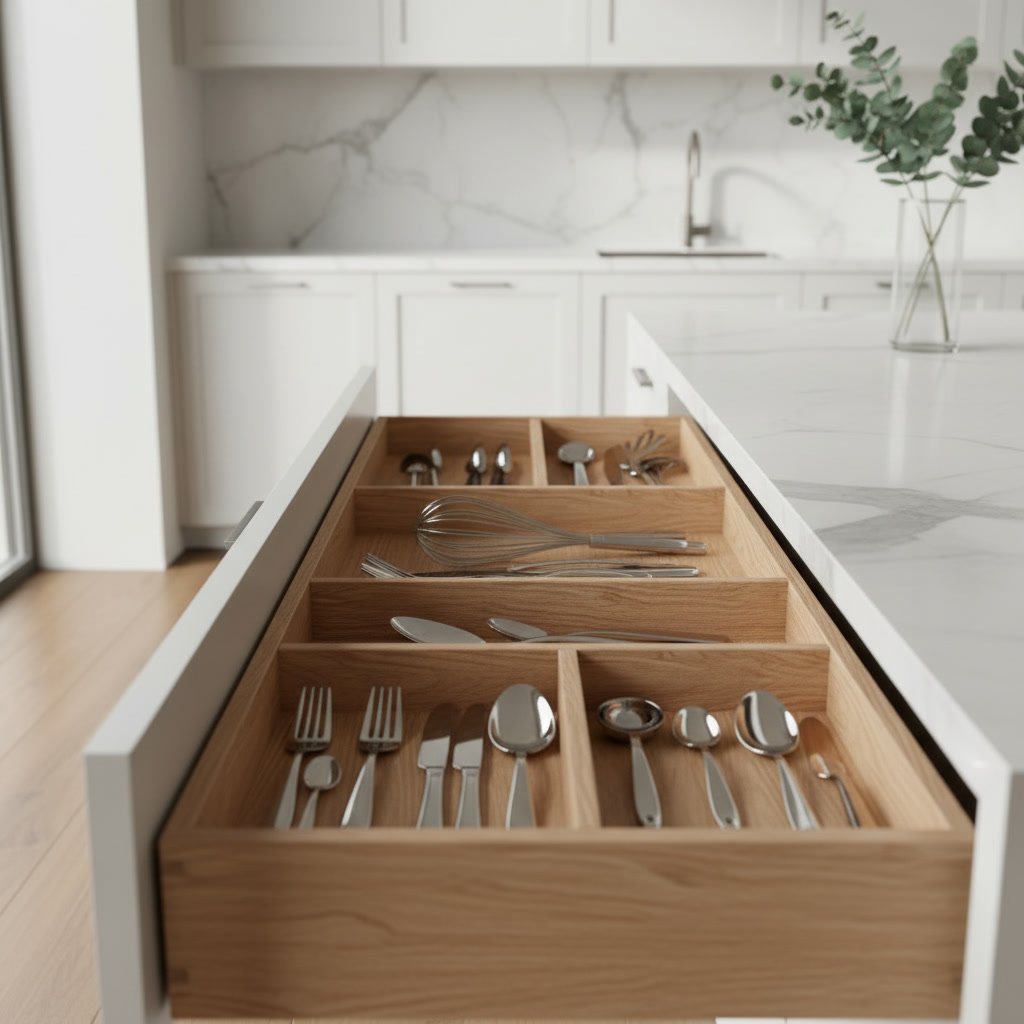
The research shows that standard dividers create wasted space because they force your tools into static rows. This is the second major design flaw. The standout 2026 feature that most deep-drawer divider sets still lack is removable, fully customizable inserts that let users reconfigure compartment widths on the fly. This feature is crucial for a deep drawer divider for pots or for a deep drawer where you store both small measuring spoons and large pastry scrapers.
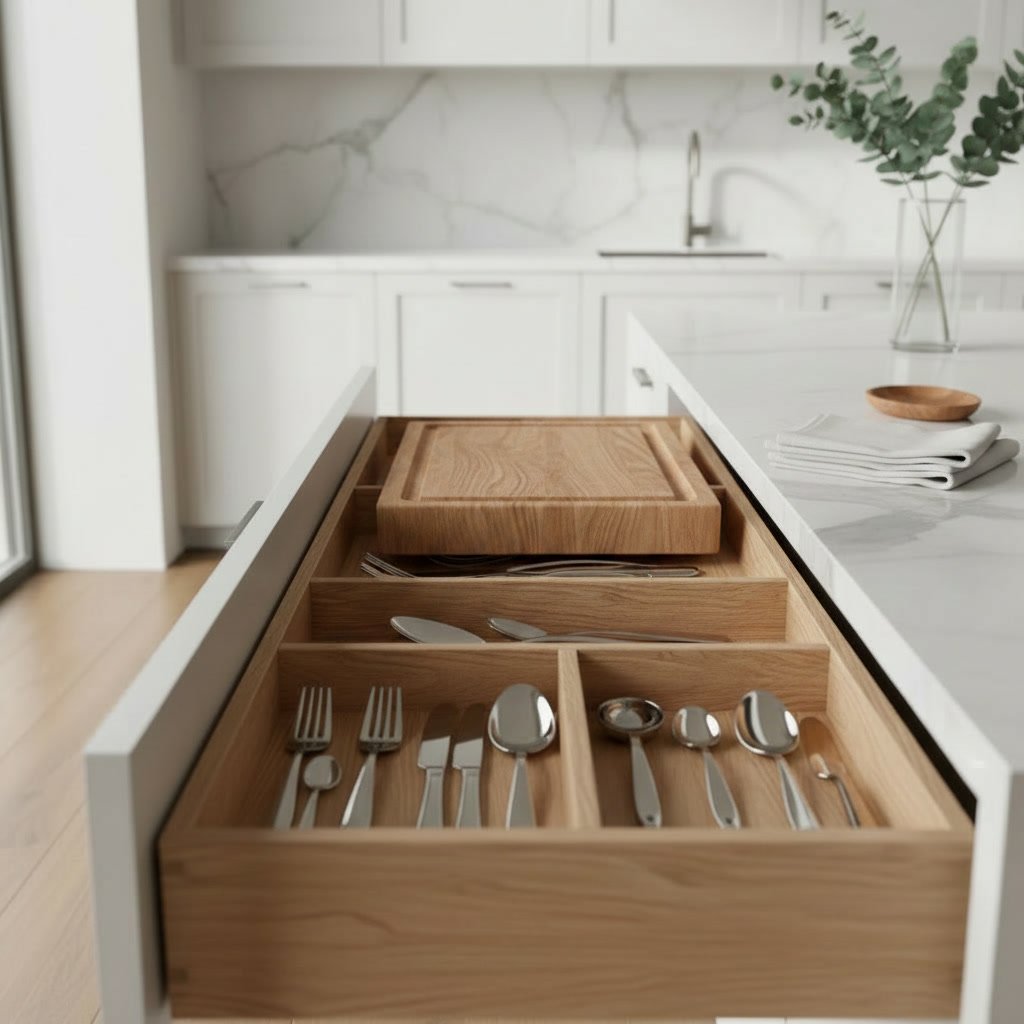
A bamboo drawer divider set that includes these removable inserts is a true “system” rather than a simple barrier. You can slide the inserts into notched slots wherever you need a separate storage space. This allows you to create tiny cubbies for cocktail stirrers next to a large compartment for your pasta spoon. It is the difference between having a drawer that *looks* organized and one that *functions* perfectly for your specific tool collection.
For an utensil drawer organizer expandable, look for models that include multiple small inserts. The best sets allow you to create a mix of long, narrow compartments (for whisks and skewers) and wider, shorter compartments (for tongs and spatulas). Without this customizability, you are just pushing the black hole problem around your drawer.
The 2026 Buyer’s Guide: Choosing a Durable Kitchen Drawer Divider
After understanding the flaws, choosing a divider becomes straightforward. You are looking for a solution that avoids aggressive springs, provides a custom fit, and uses a durable material. Here is a quick guide to the most common options.
Plastic vs. Bamboo
Plastic is cheap and lightweight, but it can scratch, warp, and break. Bamboo is more expensive, but it is stronger, more sustainable, and looks far better in a modern kitchen. If you want a “set it and forget it” solution, pay the premium for bamboo. For a guest bathroom or a rarely used junk drawer, plastic might be adequate. For a primary kitchen drawer organizer for kitchen utensils, always go with bamboo. User reviews on sites like AOL confirm that bamboo organizers are much taller than the competition, eliminating worries of spillover from deep drawers.
Adjustable vs. Custom Fit Inserts
Simple expandable dividers are fine for flatware or tools of similar sizes. But for a deep drawer, you need a set that comes with multiple small inserts. Look for phrases like “removable inserts” or “customizable compartments”. A custom fit drawer insert system is the only way to eliminate wasted space in a deep drawer used for diverse kitchen tools.
| Feature | Cheap Plastic Divider | Quality Bamboo Divider Set |
|---|---|---|
| Material | Thin, BPA-free plastic (often warps) | Thick, resilient bamboo |
| Spring Strength | Too weak (slips) or too strong (scratches wood) | Balanced with thick rubber end caps |
| Customization | Fixed rows, no inserts | Removable inserts for a custom layout |
| Durability | 1-2 years before breakage or loss of tension | 5+ years with daily use |
| Long-Term Value | Poor (replacement costs add up) | Excellent (one-time purchase) |
If you are organizing a deep drawer used for pots and large tools, the choice is clear. You need a deep drawer divider for pots that is tall, sturdy, and offers extra inserts. This specific need is why I recommend the bamboo sets with removable pieces. They provide the height necessary to contain bulky items without spillover, solving the classic “black hole” problem of deep kitchen drawers.
For further reading on organizing your entire kitchen, check out our guides on pantry organization ideas or how to maximize your space with under-sink organizers. A well-organized drawer is just one step toward a more functional kitchen.
Conclusion: Your “Set It and Forget It” Solution
Buying kitchen drawer dividers does not have to be a gamble. By avoiding the three common design flaws—aggressive springs, size mismatches, and lack of customization—you can buy a solution that works perfectly for years. The premium you pay for a quality bamboo system with removable inserts is an investment in daily sanity. You will never again have to spend five minutes untangling spatulas before you can start cooking dinner.
For the busy homeowner who is tired of their deep drawer being a black hole for tools, the path forward is simple. Choose a set that uses bamboo, features thick rubber end caps to protect your drawers, and includes removable inserts for a truly custom fit. Ignore the cheap plastic options. Your future self, opening a perfectly organized drawer and grabbing a whisk in one smooth motion, will thank you.
Ready to organize your kitchen? Check the latest price on a quality kitchen drawer dividers on Amazon to find a set that matches your drawer dimensions.
Frequently Asked Questions
What is the best material for kitchen drawer dividers?
Bamboo is the best material for long-lasting kitchen drawer dividers. It is naturally strong, resistant to moisture and warping, and much more durable than plastic. It also provides a more attractive, natural look that complements most kitchen styles.
How do I prevent my kitchen drawer dividers from slipping?
Look for dividers with thick, high-quality rubber or silicone end caps. These provide grip without needing a powerful, damage-causing spring. Also, ensure your dividers are slightly longer than the drawer width to maintain a gentle, constant pressure against the sides.
Can I use a standard divider for a deep kitchen drawer for pots?
Standard dividers are often too short for deep drawers. You need a deep drawer divider for pots that is much taller. Also, look for a set that comes with multiple removable inserts so you can create both wide compartments for pots and narrow ones for lids or mitts.
What is the difference between a basic divider and a custom fit drawer insert system?
A basic adjustable divider simply creates long, static rows. A custom fit drawer insert system includes multiple small, removable dividers that you can slide into notched slots. This allows you to create custom-sized compartments of various widths, fitting your specific tool collection perfectly and eliminating wasted space.